(German citizen Kim J. Baaden has been living in Nepal for the past 26 years, actively involved in various social and business sectors. Over the years, he has developed a deep understanding of Nepal’s business culture, internal politics , and natural resources. He has observed key turning points in the country’s modern history, from the royal massacre to the establishment of the republic, and continues to closely observe the growing political awareness among Nepal’s younger generations.
Baaden’s connection to Nepal is so profound that he says he loves Nepal more than his own birthplace, Germany. After a lively relationship with his German girlfriend, he chose Nepal over the relationship — a decision that marked a deeper personal and professional engagement with Nepal.
Initially, Kim came to Nepal for PhD research, and following the cultural crossover, he became increasingly active in Nepal’s social and business sectors. Kim operates two companies: Plus Leader Pvt. Ltd., registered in Nepal, and Impact Yes, LLC(https://impactyes.com), registered in the United States. He collaborates with co-founder Kovid Panthy, also lead trainer and 50% partner in Impact Yes. ‘Impact Yes’ is an organization through which he provides hospitality leadership training to executives and directors of four- and five-star hotels in Nepal.
He believes that due to Nepal’s immense tourism potential, there is a critical need for leadership gap analysis and leadership skills training in the hospitality industry. Only then can this destination keep up with international standards and grow.
How does Kim observe Nepal after 26 years of living here? What are Nepal’s strengths, and where does it lag behind? We explore these questions and more in our conversation with Kim. – Editor)
You have been staying in Nepal for 26 years. How was your experience here in Nepal and what factors motivated you to stay here for so long?
– I completed my Master of Science with 97% in Germany, which made me eligible for a PhD. With the support of my professor (Emeritus Professor Dr. Dr.h.c. mult. Manfred Domroes) and the GIZ organization, I began my doctoral studies. At the same time, I had the privilege of being a member of an elite German group for gifted scholars, where I deepened my knowledge of philosophy, ethics, and leadership. My primary academic subjects were Geography, Psychology, and behavioral science.
As part of my doctoral work, I needed to select an international research location. So, I visited five different countries in Asia to evaluate potential sites. During this process, I also visited and evaluated various projects run by the GIZ organization. Finally, I found that Nepal was the most appropriate location for my research. Then I started my geographical research in Nepal, focusing on the Chure Range.
My specialization was in forest resource management. To conduct my fieldwork, I lived in Udayapur for one year (1996) and Siraha for the following year (1997), leading a team of research assistants. During this time, I identified more than 600 botanical species that could also be used for medical purposes. My aim was to empower villagers to generate income from locally available renewable resources. However, due to the impact of the Maoist insurgency at that time, I could not complete my PhD. I had to discontinue my doctoral studies and founded my company.
I came to Nepal for 1 year of research, and today I have already spent 26 years. I enjoy living in Nepal. I love Nepal and her culture, and contributing to the nation’s development and growth.
Forest eco-systems have always been my keen interest, personally and academically. Global warming is increasing year by year. The negative implications for the environment are significant, also in Nepal.
What impact does global warming have on countries like Nepal? What can we do against deforestation?
– Since this was my academic interest, I conducted research on forest resource management in Nepal. GIZ had a community forestry project near Lahan, which I worked on. The concept of community forestry was based on the principle that protecting herbs helps protect forests, and protecting forests, in turn, helps protect human communities. And local resources could be used for their livelihoods and income generation.
What do you think are the reasons for the effects of global warming in Nepal and what are the long-term effects it could have on Nepal?
– The main causes of global warming originate outside Nepal; industrialized countries bear the primary responsibility. These nations should support countries like Nepal in mitigating the impacts of climate change. However, agriculture also plays a significant role in global warming, and Nepal contributes to this as well. For instance, consider the recent spikes in air pollution observed in Nepal, often caused by the burning of agricultural residues.
Due to global warming, glaciers are melting. The white mountains are turning into black mountains. Water sources are drying up. Run-of-the-river-based hydro projects will be useless after 15 years. Therefore, Nepal should now start looking for an alternative in the form of solar energy for long-term energy security. Even a 1-degree Celsius increase in global warming can have a huge impact.
Are countries like the US backing away from their obligation to compensate nations like Nepal and others in the Global South? In this context, the question of who the environment is for has also arisen, hasn’t it?
– It’s not a question of compensation but of prevention and, sadly, of mitigation. The US Trump administration pulled out of the UN climate process and backed fossil fuels. On the other hand, the EU committed to legally binding targets to cut emissions drastically by 2030 and reach climate neutrality by 2050. Here we see the huge difference in levels of global responsibilities.
Apart from this, each single country carries responsibilities, also Nepal. My research focused on ‘community forests’. If we can preserve these forests by making them economically interesting, we also help in the process of global warming. I principally question the effectiveness and suitability of international development cooperation projects in Nepal. Massive funds are invested. I sometimes think, where can we see the long-term impact. That’s why I rejected an offer by an international development agency to earn 5 lakhs per month, and thought, better I contribute by myself as per my capabilities and limitations.
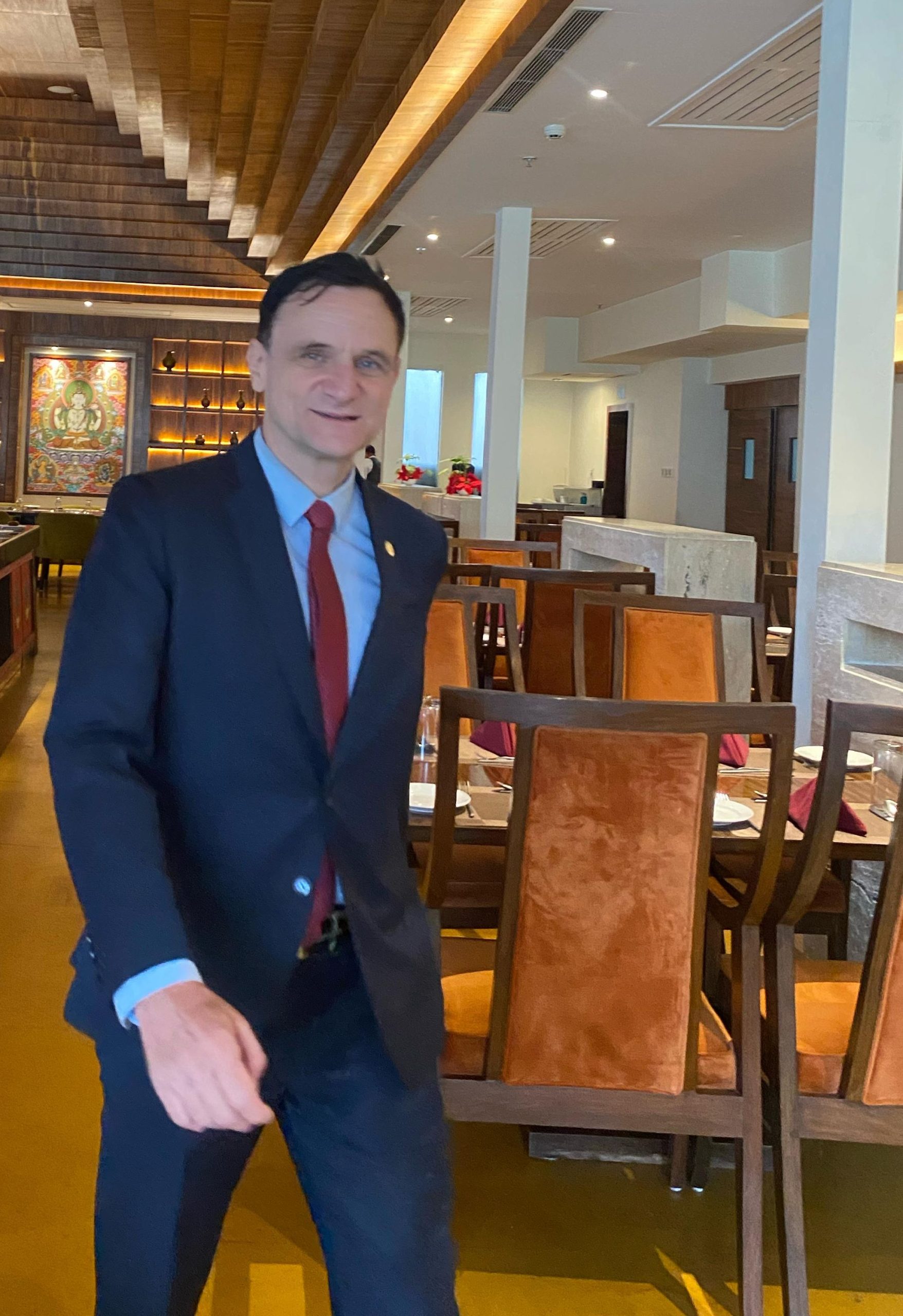
Let’s change the context, now in what field are you engaging, can you share with us?
– We are in hospitality. We provide soft-skills training for the executive level of 4–5-star hotels. This includes training in leadership, entrepreneurial thinking, and marketing acumen. We currently focus here on our unique ‘leadership gap analysis’ training program.
For that, we started ‘Impact Yes’, LLC, (https://impactyes.com)our company in the USA, for global business. Kovid Panthy and I registered our company together. So, we are the co-founders. We did that in the year 2021, when Kovid was 17 years old. Kovid already registered his first company in Nepal at the age of 15. While many companies were shutting down during the COVID-19 pandemic, we were starting a new one. Going against the stream is the hallmark of entrepreneurship. That’s what we stand for!
How did you make the switch from Geography to Leadership?
– Once you learn how to conduct research, you can apply the same principles to almost any field. I applied these principles to the field of leadership. Why leadership? Because people frequently put me into leadership positions, even when I didn’t apply for them. I served in the army, the German Air Force, where I held a leadership position and achieved 100% performance results. I was a leader on a jungle expedition through Borneo. I became a leader in various settings, including youth camps, discussion groups, business groups, and within my own companies and ventures.
I experienced firsthand how vital leadership is for the growth of both humanity and business. So, I academically researched ‘leadership’ for 7 full years, before I developed the current unique concepts. Together with Kovid, we brought everything to the next level, which is now very unique worldwide. Thanks also to our team behind! And thanks to my memberships in international leadership associations, we keep up with the latest developments.
Above you mentioned about ‘leadership gap analysis’. What does that mean?
– Before our seminar even starts, our participants take a leadership assessment. Here, each hotel executive will get to know where they stand in terms of leadership preferences. They get real numbers. In our seminar, we will compare those personal results with global leadership benchmarks. Here we often find gaps. And in our seminars, we close these gaps. By that, each person can become a more powerful leader. And, very important, the whole leadership team in the hotel gets aligned. They speak with the same language of leadership and move forward more impactful.
Training programs we already have conducted at top hotels like Marriott, Yak & Yeti, and Soaltee Crowne Plaza. Most recently, just a week ago, we signed a new training MoU with Ramada Encore, Kathmandu. The press has reported extensively on this.
How did you find out that leadership gaps are so important in the hospitality industry?
– We have talked to many General Managers and Hotel Owners from Nepal, India, Sri Lanka, and Dubai. What they always told us again and again is, that their executive team is not really aligned. Yes, each executive is excellent at what they do, in their specific domain. However, when it comes to domain-overlapping strategy building, then that’s where leadership skills are needed. We were told, and have observed, that everybody has different views about what leadership is, and how it should be applied. Many of these are personal opinions about leadership, or what they have been grown up with at home, or self-studied in available online resources.
That’s where we come in: We use the most successful and powerful leadership system in the world, which is well researched. It is extremely impactful in any kind of situation. That’s why this is often called ‘the gold standard of leadership’. Our newly developed concept is based on that. It not only identifies personal leadership gaps, but also closes them, forever.
What do you want to achieve with your ‘Leadership Gap Analysis’?
– Our target is to increase the arrival of higher-spending travelers, to increase Nepal’s GDP and foreign exchange reserves. This can be achieved by improving the hospitality reputation of Nepal, which again depends on excellent hotel leadership.
That’s exactly where we work on: To improve the KPIs (Key Performance Indicators) of the hotels, such as the MPI (Market Penetration Index) and RevPAR (Revenue Per Available Room), among others. Good hotel leaders will address these KPIs by pulling on the same rope, in team work. Our target is to align the leadership teams for maximized top-performance. We will bring them from the level of professionals to elites. They easily can compete world-wide with these new skills.
How does this impact Nepal as a country?
– Each hotel is like an embassy: Representing the country and showcasing its culture and national identity. Ideally, this should include global-level service excellence. While the infrastructure of a hotel might be quite similar everywhere, what really counts is the human factor – the behavior of the hotel staff. That makes the real difference.
A hotel doesn’t primarily sell rooms; it sells emotions. Hotel guests seek experiences and the chance to make lasting memories. If this experience is positive or negative, largely depends on the service excellence displayed by the hotel staff. This, in turn, depends on hotel leaders and their ability to motivate and inspire their teams. If hotel leadership is strong, the hotel will make a positive impression on guests.
This positive impression then reflects on Nepal as a nation, because guests go home and tell their friends about their experience in the country. This is exactly where leadership in hospitality impacts a country’s reputation – hopefully positively, driven by new elite leaders in action.
Are you also active in other areas/fields?
– Yes, I am also a member of the Rotary Club. Kovid is also Rotary Club member, the youngest in Nepal/Bhutan, and currently serving as a club secretary. Kovid is extremely active, I can say, and a true leadership driver for his club. I am a Past President and have been a Rotarian for 22 years.
I was the president of the Rotary Club from 2007 to 2008. Rotary plays a big role in bringing about changes in the social and environmental sectors. In some cases, they can be more impactful than Governments. It is a powerful organization, in a positive sense of power – as we ‘serve above self’ with ethical mindset.
Apart from this, I also do social work as a private initiative. During the 2015 earthquake I was in Kathmandu. Directly 5 days later, my team and I organized rescue and relief work in Sindupalchowk and other places. We worked together with the Nepali Army at that time. And I really was very impressed by the work of the Nepali Army. My sincere respect! With Rotary we also provided extensive support to people directly after the earthquake and during the Covid-19 pandemic. It was very risky, but it was our duty as human beings.
You have the experience of working for such a long time. What do you think Nepalis should pay attention to in order to make Nepal prosperous?
– Nepal is currently moving into the right direction with democracy. After the Maoist People’s War, many democratic structures have been established in Nepal. Democracy should not be misused. The current time is for political transformation.
In the current era of globalization, digitalization, and information technology (AI), it is necessary for the young generation to come to the level of political leadership in Nepal. Such youth who are not economically or politically corrupt, love Nepal very much, are honest and courageous, and can balance both neighboring and friendly countries, such youths need to come to the leadership. If that happens, Nepal can be developed, Nepal can be made prosperous.
Is it just a dream? No! First believe in yourself. Then get leaders with the right ethics and global mindset. Finally: Transform! Yes, Nepal can do it!